
Introduction
Are you spending money on marketing but unsure if it’s paying off? You’re not alone. For owners of local service businesses, like yoga studios, wellness centers, or personal training practices, knowing what’s working (and what’s not) is the difference between consistent growth and wasted dollars.
That’s where ROI (Return on Investment) comes in. It’s not just a metric, it’s your decision-making superpower. When used right, ROI helps you focus on what truly grows your business, so you can stop guessing and start scaling with confidence.
Imagine investing in marketing channels that reliably bring in new clients, without overspending or flying blind. Let’s explore how to measure, compare, and maximize ROI for your local service business.
TL;DR:
This guide breaks down how to calculate, compare, and improve ROI across key marketing channels, so you can grow your local service business confidently and efficiently.
Why ROI Is Critical for Local Service Businesses
If you’ve been in business for a while, you’ve probably dabbled in a range of tactics, Google Ads, flyers, social media boosts, email newsletters, maybe even a few local partnerships. But which ones are generating results?
Here’s why ROI matters:
It reveals what marketing efforts are truly profitable
It eliminates wasteful spending
It gives you the confidence to test new ideas
It empowers smarter decisions, especially on a tight budget
For local service businesses built on trust and community, every dollar needs to work harder. ROI helps ensure it does.
What Is ROI?
Return on Investment (ROI) is a simple formula that shows how much profit you make from your marketing spend:
ROI = (Revenue – Marketing Costs) ÷ Marketing Costs × 100%
Example:
Spend $500 on Meta Ads. Generate $2,000 in class sign-ups.
→ ROI = (2000 – 500) ÷ 500 × 100 = 300%
The higher the ROI, the stronger your return—and the smarter the spend.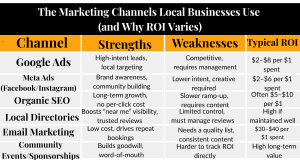
How to Track ROI for Each Channel
To get clear on ROI, you’ll need to track 3 things:
Leads Generated – New sign-ups, bookings, or inquiries
Revenue Earned – How much money each campaign brought in
Costs Incurred – Ad spend, content creation, software/tools
Pro Tip: Use tools like:
UTM Parameters – To track link performance
Call Tracking Numbers – For phone-based leads
CRM Systems – To trace leads from ad to sale
Channel-Specific ROI Breakdown
1. Google Ads
Pros: Targets people already searching for your services
Cons: More competitive in busy markets, needs monitoring
Best for: Immediate bookings and high-intent traffic
ROI Example:
Spend $200 → Earn $1,000 → ROI = 400%
2. Meta Ads (Facebook/Instagram)
Pros: Great for telling your brand story, building awareness
Cons: Less direct response, requires consistent creative
Best for: Building a loyal community and retargeting warm leads
ROI Example:
Spend $100 → Earn $400 → ROI = 300%
3. Organic SEO
Pros: Brings in long-term, free traffic
Cons: Requires patience and regular content
Best for: Sustainable growth without ongoing ad spend
ROI Example:
$1,000 invested in content over 6 months → $7,000 revenue = 600%+ ROI
4. Local Directories (Google Business Profile, Yelp)
Pros: Essential for local searches, builds trust
Cons: Requires review management
Best for: Visibility, social proof, and organic leads
5. Email Marketing
Pros: Extremely cost-effective, drives repeat business
Cons: Requires a quality list and ongoing nurturing
Best for: Retention, upselling, and community engagement
ROI Example:
$0 spent on an email to your list → $500 in sales = Infinite ROI
6. Community Events & Sponsorships
Pros: Great for brand building and buzz
Cons: ROI isn’t always measurable
Best for: Word-of-mouth and long-term brand equity
Factors That Affect ROI
Local Competition: Higher demand means higher CPCs, but also more potential customers
Pricing & Margins: Higher-ticket services can support higher ad spend
Customer Lifetime Value: Repeat clients multiply your ROI
Lead Quality: Focus on qualified leads, not just traffic
Seasonality: Plan for spikes in January, spring, and fall are big in wellness
Tips to Maximize ROI as a Local Service Provider
✅ Target High-Intent Search Terms:
Use Google Ads to target “yoga classes near me” or “massage in [city].”
✅ Combine Channels Strategically:
Use Google Ads to capture ready-to-book leads, Meta Ads to retarget and nurture, and SEO for long-term traffic.
✅ Showcase Social Proof:
Highlight reviews, testimonials, and before/after stories in both ads and on your website.
✅ Track Weekly, Optimize Monthly:
Monitor campaigns and shift your budget based on real results, not assumptions.
✅ Use Geo-Targeting:
Focus all your paid campaigns on a 5–10 mile radius. Hyperlocal targeting = higher ROI.
Real-World ROI Example
Let’s say you run a yoga studio and want to promote your new beginner class:
Google Ads:
$200 spend → 25 sign-ups → $1,250 revenue → 525% ROIMeta Ads:
$100 spend → 10 sign-ups → $500 revenue → 400% ROIEmail Marketing:
$0 spend → 5 sign-ups from your list → $250 revenue → Infinite ROI
Takeaway: Use a mix of fast-acting channels like Google Ads and high-ROI channels like email to cover both short-term and long-term growth.
Conclusion: Let ROI Guide Your Growth
Tracking ROI isn’t just about getting numbers, it’s about gaining clarity. With every dollar you spend, you should feel confident it’s helping your local service business grow.
By measuring what works, trimming what doesn’t, and doubling down on high-return channels, you’ll turn your marketing into a profit engine and spend more time doing what you love.
Want more proven ways to grow your business without wasting your budget?
📘 Download our free guide: “How to Laser Target New Customers Who Need Your Help, RIGHT NOW.” Learn the exact strategies top-performing local businesses use to maximize ROI and fill their calendars.